

Do I Need a Survey to Buy a House in Miami?
If you’re buying a home in Miami, you may be asking yourself:
“Do I need a survey to buy a house in Miami?”
The short answer? In most cases — yes, or you should strongly consider one. While Florida law does not automatically require a survey for every residential purchase, lenders, title companies, and insurance providers frequently do. In a market like Miami and throughout Miami-Dade County, skipping a survey can expose buyers to unnecessary legal and financial risk.
Let’s break it down clearly.
When Do Lenders Require a Survey?
Most lenders financing property in Miami or anywhere in Miami-Dade County require a property survey before closing. The reason is simple: lenders need to verify that the home they are financing sits entirely within the legal property boundaries and that no boundary or encroachment issues could affect the property’s value or marketability.
A survey helps confirm that:
The structure is fully within the property lines
There are no encroachments from neighboring properties
Improvements do not violate setbacks or easements
The existing improvements match public records
If a lender is issuing a mortgage, they want to eliminate boundary uncertainty before funding the loan. While some cash buyers choose to waive a survey in competitive situations, doing so can create significant problems after closing.
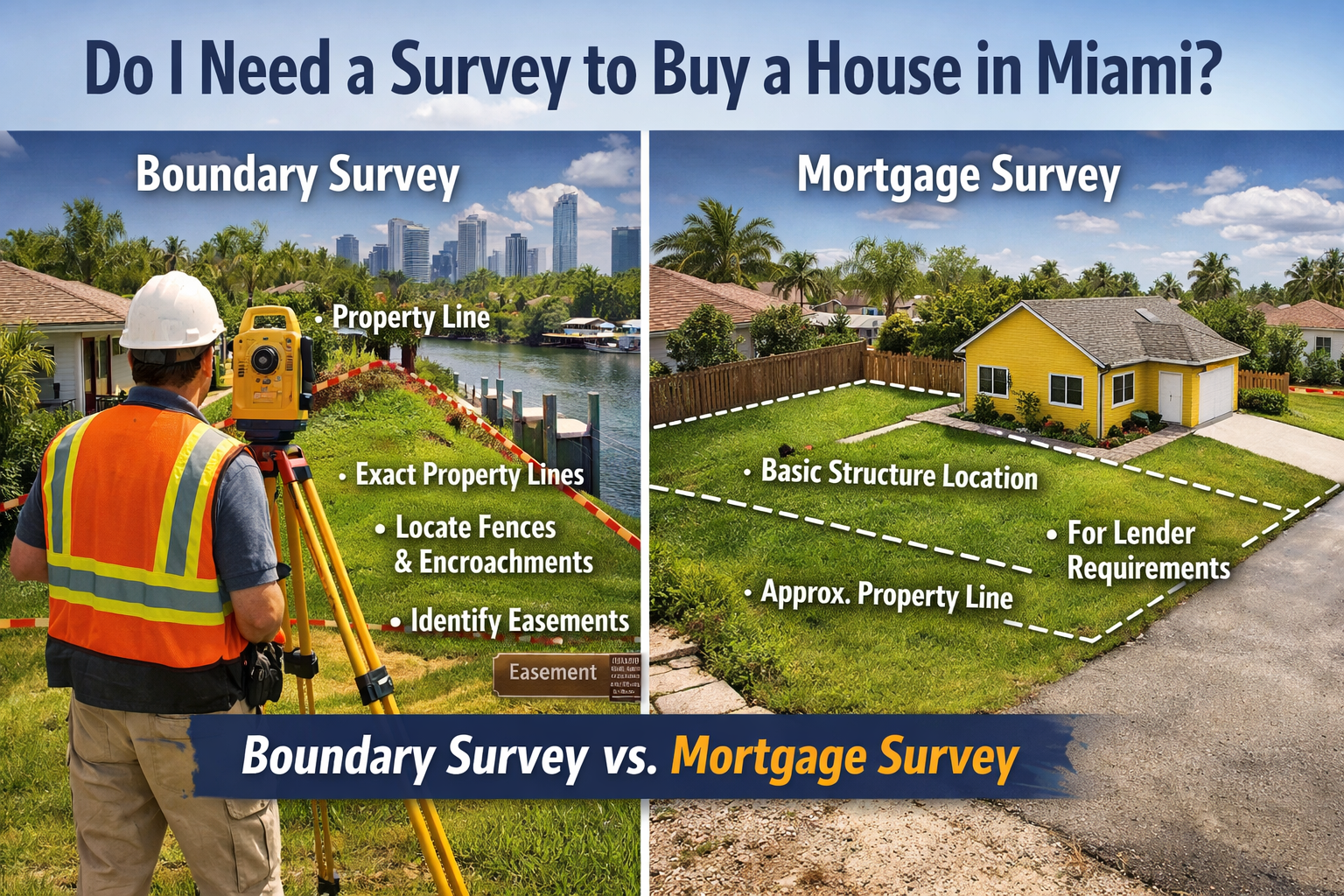
Boundary Survey vs. Mortgage Survey: What’s the Difference?
Many buyers assume a “mortgage survey” and a boundary survey are the same. They are not.
Boundary Survey
A full boundary survey is the most comprehensive option. It establishes the exact legal property lines, locates fences, structures, driveways, and visible improvements, identifies recorded easements, and produces a legally defensible map prepared by a licensed surveyor. This type of survey provides the highest level of protection for buyers.
Mortgage Survey
A mortgage survey is typically more limited in scope. It focuses primarily on showing the relationship of structures to property lines and is often prepared to satisfy a lender’s minimum requirement. While it may meet underwriting standards, it may not provide the same depth of protection as a full boundary survey.
In South Florida, where lot lines are often tight and fence encroachments are common, a full boundary survey is usually the wiser investment.
Do Title Companies Require a Survey?
Most title companies in Miami request a survey in order to issue title insurance without boundary-related exceptions. Without a current survey, a title policy may exclude coverage for encroachments, boundary disputes, or easement conflicts.
In practical terms, this means that if a problem arises after closing, you may not be protected. A survey allows the title company to identify and resolve potential issues before the transaction is finalized, protecting both the lender and the buyer.
Why Skipping a Survey Is Risky in South Florida
South Florida properties present unique conditions that increase the importance of a survey.
Fence encroachments are extremely common, with fences sometimes installed inches or even feet over a property line. Utility and drainage easements frequently affect residential lots throughout Miami subdivisions. On waterfront properties, legal boundary lines often do not align perfectly with visible seawalls or docks. Flood zone considerations also play a major role in real estate transactions, and accurate boundary data helps confirm structure placement relative to mapped flood areas. In older Miami neighborhoods, original monuments may have shifted, deteriorated, or been disturbed over time.
Once you close, any boundary issue becomes your responsibility to resolve — and legal disputes can be costly.
Is a Survey Required by Florida Law?
Florida law does not universally mandate a survey for every residential purchase. However, most financed transactions require one, and many title companies strongly recommend obtaining a current survey even for cash purchases. Real estate attorneys often advise buyers to secure a survey to avoid future disputes, and certain insurance or permitting situations may also require updated boundary documentation.
Even when not strictly required, a survey is often a financially prudent decision.
What Does a Property Survey Before Closing Cost in Miami?
Survey costs vary depending on factors such as lot size, whether the property is waterfront, the complexity of historical research required, and requested turnaround time. Compared to the overall cost of purchasing a home in Miami, a survey is typically a relatively small investment that can prevent significant legal expenses later.
So… Do You Need a Survey to Buy a House in Miami?
If you are financing the home, the answer is likely yes. If you are paying cash, you may not be required to obtain one, but choosing to skip it could expose you to boundary disputes, fence conflicts, easement surprises, title insurance gaps, and future permitting complications.
In a high-value and highly regulated market like Miami, a survey provides clarity, legal protection, and peace of mind before closing.
Purchasing a home is one of the largest financial decisions most people will make. A professional land survey ensures you understand exactly what you are buying — not just the structure, but the land it sits on. Consulting a licensed Miami land surveyor early in the closing process can help you avoid surprises and move forward with confidence.